 Long Walk Back
Electric unicycles, and whatever you ride next
Get lost, not stranded
Long Walk Back reads your wheel over Bluetooth, prices the road ahead against the terrain and your own riding, and holds one promise for the whole ride: there is still a way home on the charge you have left.
The iPhone build runs on TestFlight and is open to anyone with the link. It needs iOS 16.2 or newer. The Android build needs Android 12 or newer. Play admits an Android tester by address, so mail the Google account your phone signs in with and I will add you.
The field
One color, and nothing to read
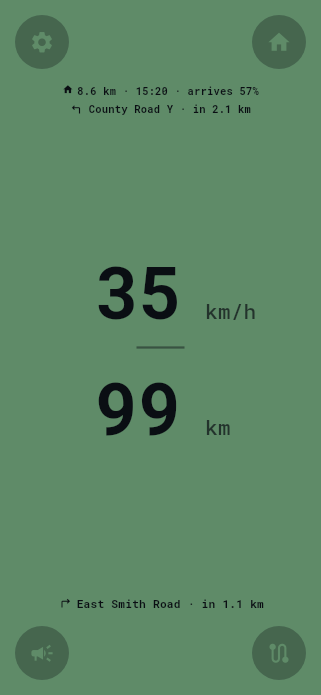
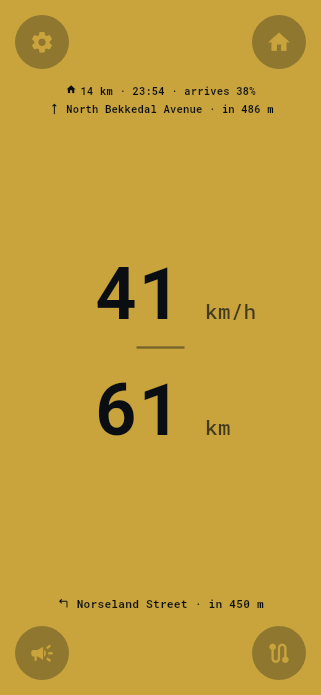
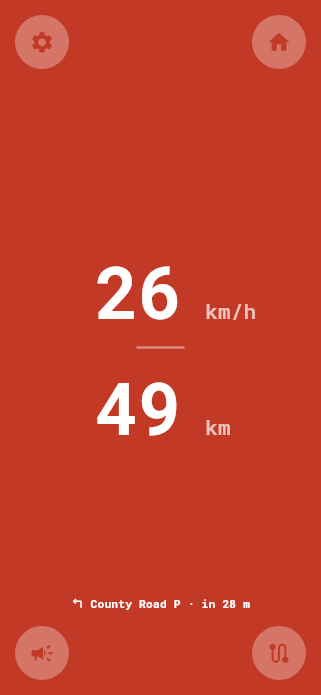
The screen you ride with is a field of color and two numerals. The color answers one question: does the charge left still cover the way back? It is checked against the roads that are actually there, continuously, for the whole ride — not once before you leave, and not against a straight line.
- Green. You get home with the reserve you set still whole.
- Amber. You arrive inside that reserve. Ease off, and the margin comes back.
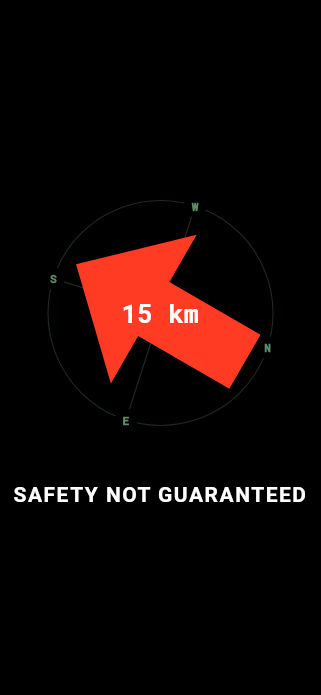
- Red. On these numbers you walk the last of it. Turn for home now.
The rides
It suggests the ride, and prices it first
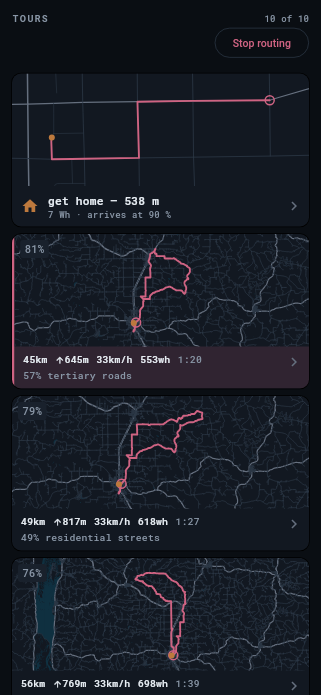
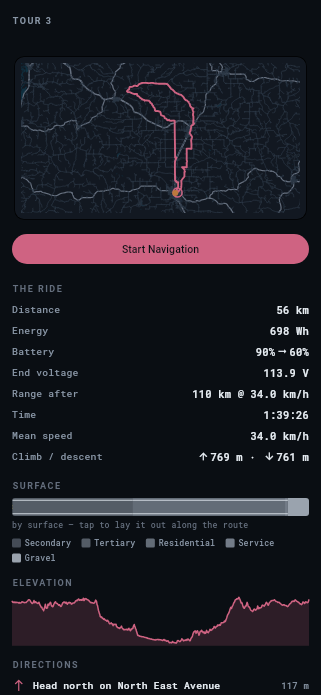
Ask for nothing and it plans a loop: spend the battery you have, take ground you have not covered lately, be home with the reserve intact. Every ride in the list arrives costed — distance, climb, watt-hours, pace, and the charge left when you get back. You pick one, or you keep riding and it keeps offering.
The mix
You set the mix, and the ranking follows it
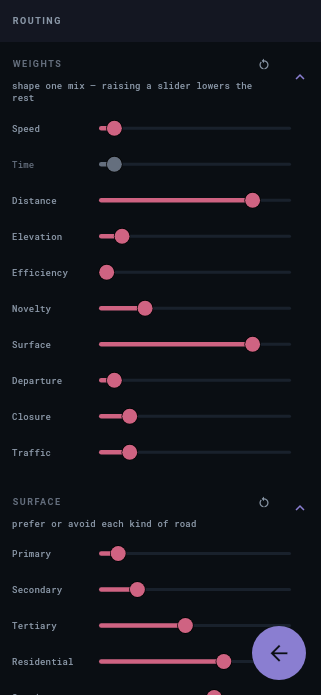
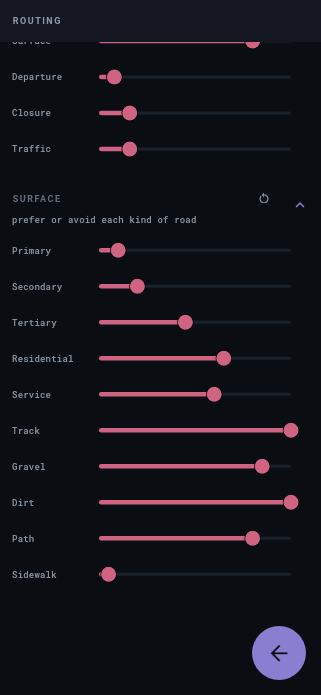
Speed, scenery, novelty, efficiency, elevation, surface: one mix, where raising a slider lowers the rest. Prefer gravel, avoid sidewalks, road class by road class. The reserve is not in the mix. You set it, and no ride that spends it is ever offered.
The instruments
Every gauge, and consumption over the last twenty metres
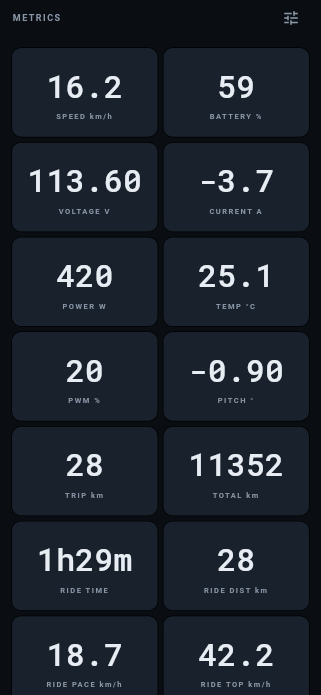
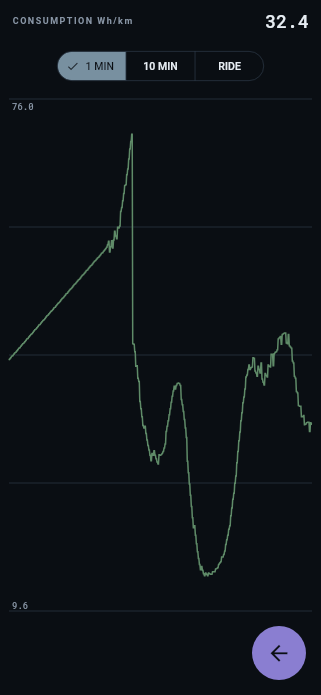
Speed, battery, voltage, current, power, temperature, PWM, pitch, trip: choose the tiles and order them, and any tile opens as a chart of the whole ride. Consumption is the rate over the last twenty metres of ground, not the average since you left. It says what this hill is costing while you are still on it.
The vehicle
What a season has done to the pack, and to the tire
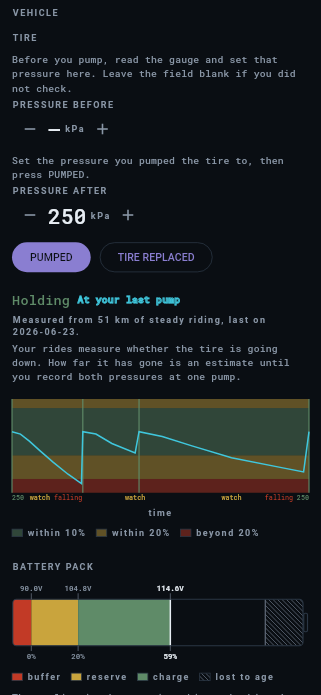
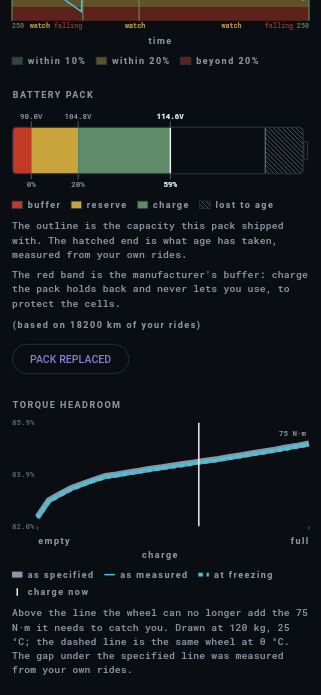
- The pack is drawn as a battery: the outline is the capacity it shipped with, and the hatched end is what age has taken.
- What age has taken is never given a number — it is an estimate, so it is drawn as a share of the outline rather than printed as a percentage.
- It is measured from your own rides, not from the pack's age and not from a datasheet, and the line under it says how much riding it rests on.
- The tire half is a log you write, and the app reports whether the tire is going down. It never states a correct pressure: that depends on the tire, the rim, your weight and the ground.
- The figure at the foot is how much duty the wheel can still use before it runs out of the torque that keeps you upright — as specified, as your rides have measured it, and at freezing.
The relay
It shares the wheel instead of owning it
A wheel accepts one Bluetooth connection, so a telemetry app normally owns it for the whole ride. This one takes that connection and re-serves the wheel's own Bluetooth shape while it records — other devices see the wheel, not an app. A second phone on the handlebars, a watch on your wrist: each one reads the same live stream, at the same time, from a wheel that only ever held one link.
Why a second app
It reads the wheel and the map together
Dashboards do not route
The telemetry apps read a wheel well and say nothing about the road ahead. Their alarms fire on what is happening now. This one is about the next ten kilometres.
Route planners do not know your pack
An elevation profile is something for a human to eyeball. Long Walk Back runs a physics model of your vehicle over grade, surface and pace, and answers in watt-hours.
It learns your wheel
Every ride you record teaches it how your pack has aged and what your riding costs. While it is still unsure it stays conservative: the floor underneath is arithmetic that needs no learning at all.
Nothing here is locked in
Rides export as the CSV the community's tools already read, and the relay above re-serves the live stream. Using this app costs you none of the ones you have.
Privacy
It sends nothing on its own
No account. No analytics. No advertising. No third party. Your rides, your location and your settings stay in the app's own private storage on your phone. The app makes one request by itself and it is a download: the map of a numbered square of ground. It does not send where you are.
One thing can go up, and only if you ask for it. You can send us a single ride — to report a problem, or to help build the range model. One ride, one tap, after a screen that states what that ride holds. It travels sealed, and we can read what you send: reading it is the point of sending it.
What we build next keeps that shape. Everything is sealed under keys that only your phone holds, so the copy on our servers is unreadable — to us included — and signing into the web is your phone delegating a browser it can see, not an account with us that a password reset could take. The app holds no email address, no password, and no account for anyone to ask us to restore.
This site is a static file. It sets no cookies, runs no analytics, and loads no third-party script, font or image. Read the privacy policy.
Where this is now
In testing
- iOS 16.2 or newer, Android 12 or newer That is an iPhone 8 or later. The Android floor is where Android 12 split the Bluetooth permissions: below it the pairing screen cannot ask for what it needs, and this is a floor set before the first public install rather than after.
- Ridden and tested on two phones The developer rides with an iPhone 13 mini and a Galaxy A16 5G, and every field measurement in this project came off one of them.
- Both betas are open The iPhone build installs through TestFlight, and the link at the top of this page is all it takes. Play has no link of that kind, so I add an Android tester by hand. Mail store@longwalkback.com with the Google account your phone signs in with: that is what Play lists a tester by, and it goes on that list and nowhere else.
- Four wheel protocols today Veteran, KingSong, Begode/Gotway with the ExtremeBull wheels that ride the same wire, and Inmotion's V2-era wheels. The engine was built vehicle-agnostic from the first line — e-bikes, scooters, boards and e-motorcycles follow the protocols.
- Any landmass on the planet The map of the square of ground you are on is compiled on demand from the global road data and a worldwide elevation survey. There is no country list, and no region to buy.
The beta is open on both platforms.
The model earns its numbers on real rides, and the rides behind it are one rider's on one wheel. Yours are the ones it has not seen. What a tester reports gets read.